
The Declaration Is Our Great Unity Document
An article and a webinar

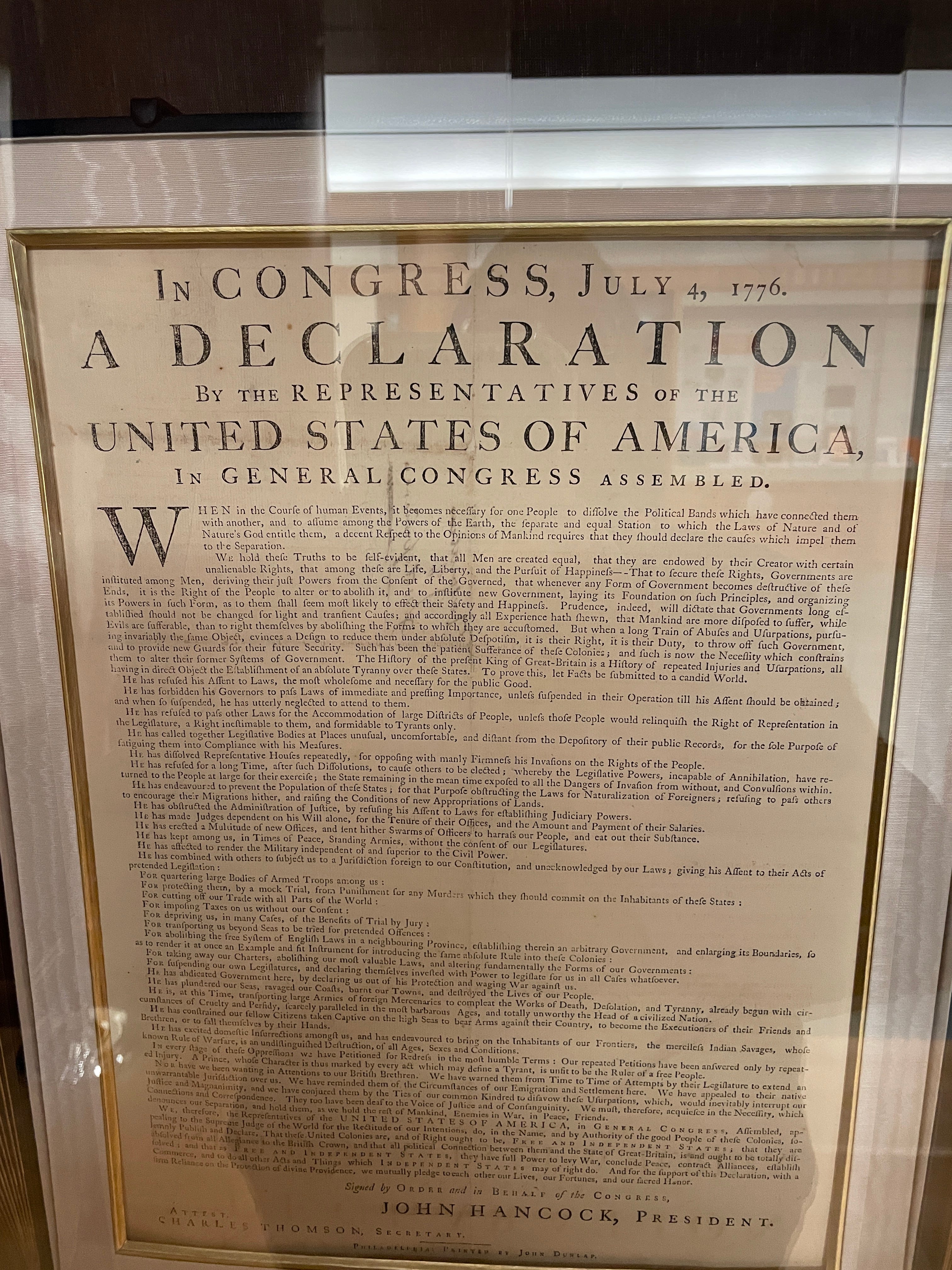
(Unique Dunlap Broadside printed on parchment, in the vault of the American Philosophical Society. Photo by author (hence the reflection).)
I grew up reading American Heritage magazine and my room was filled with their wonderful books (it was mostly the illustrations that attracted me, I admit). So, it's a particular pleasure to publish with them this essay on how the Declaration of Independence is our great unity document. An excerpt:
Jefferson, Franklin, and members of the Continental Congress hoped that the Declaration’s philosophy, its principles on the nature and ends of a just government would be understood, cherished, and promoted by all Americans. Tribalism, whether ethnic, racial, or religious, was not the goal envisioned by the Signers. They hoped to bring together a united people, diverse in faith, culture (what David Hackett Fischer called “folkways”), interests, abilities, and the like, but all vowing allegiance to ideals of liberty and equality that were inspired by Judeo-Christian and English enlightenment values.
The umbrella over the Declaration's liberty and equality claims–which have sometimes clashed, but more often coalesced–is the idea of the "one people" in the Declaration's first line. The great threat to the Union, feared by George Washington, Daniel Webster, and Abraham Lincoln, among others, was disunity, fracture, and civil discord. The Declaration succeeded when appealed to as a unity document, and it failed when employed for separatism.
The essay is free to all, filled with great illustrations thanks to Ed Grosvenor, the publisher of American Heritage, and I hope you enjoy it. It’s the first of what I plan to be many articles on the Declaration, most timed for the release of National Treasure on May 5. Please do pre-order the book, if you haven’t yet; I’ll have some announcements on book events coming up, as well.
The first one took place last week, a Hoover Institution webinar on the meaning of the Declaration. In a session moderated by Jane Kamensky, the CEO of Thomas Jefferson’s Monticello, I discussed the origins of National Treasure and how we should think about the Declaration during the Semiquincentennial, among other topics. I thought it was a great discussion, and if you didn’t see it live, you can watch the hour-long video here.