
Happy Draft Day!
A once-in-a-lifetime opportunity to see Jefferson's draft of the Declaration of Independence is coming soon

Two-hundred-and-fifty-years ago today, June 28, 1776, Thomas Jefferson handed in his draft of a Declaration of Independence to the Continental Congress. Immortalized by John Trumbull in 1818 in his masterpiece painting hanging the U.S. Capitol Rotunda, June 28 began the final countdown to Independence.
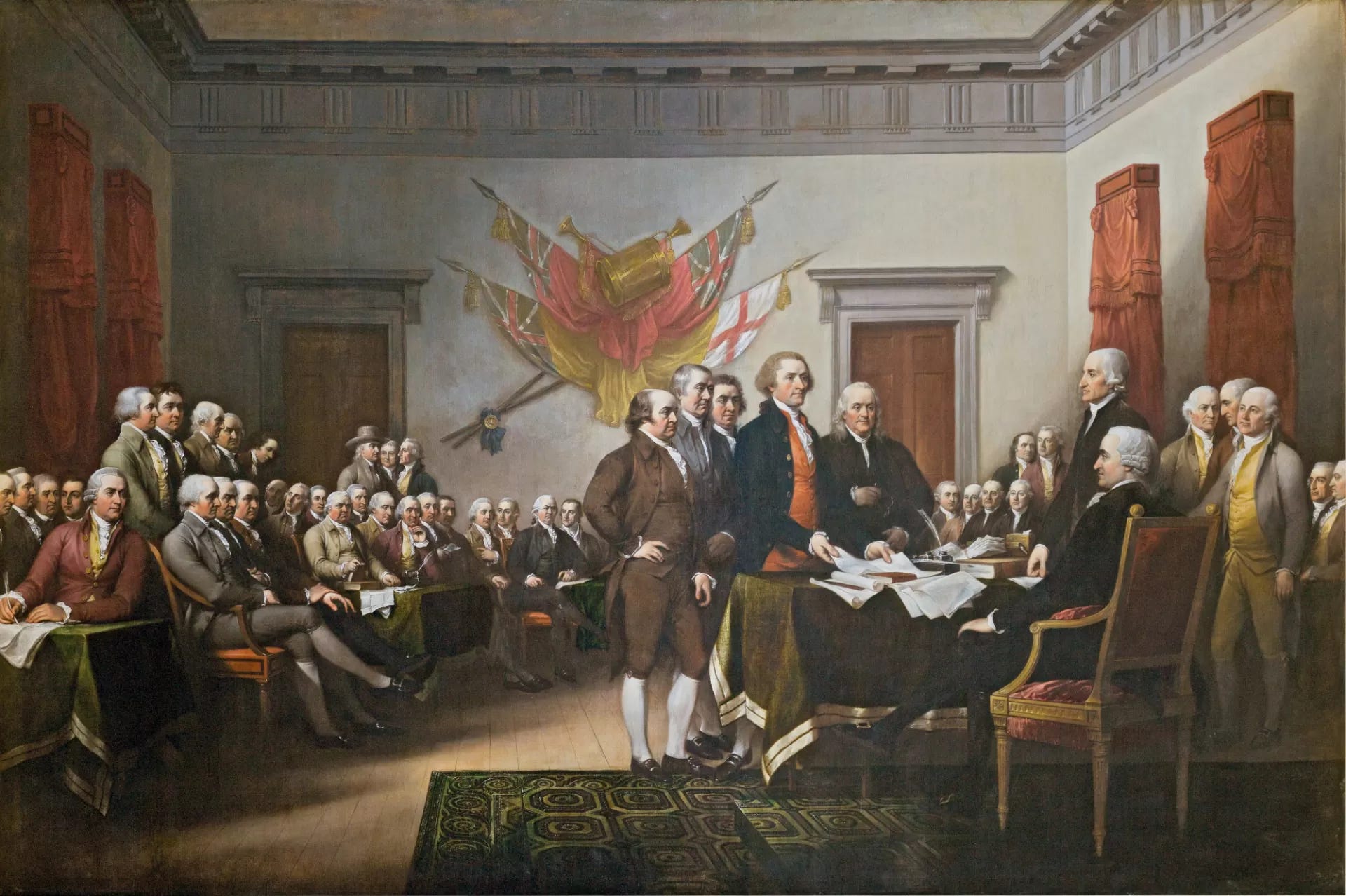
(John Trumbull, “The Declaration of Independence”; image from Architect of the Capitol.)
As I write in National Treasure: How the Declaration of Independence Made America, Trumbull’s scene was entirely fanciful, for Congress was in recess on June 28, and almost certainly no one, including John Hancock, was seated in ranks to watch the moment that Jefferson gave his draft to Charles Thomson, secretary of Congress.
And yet, June 28 remains a red-letter day in American history. Congress had gone into recess on June 11, appointing a committee to prepare a draft in expectation of a successful vote for Independence on July 1, when it was to reconvene.
The Committee was comprised of John Adams, leader of the Patriot cause in Congress, Benjamin Franklin, Robert Livingston of New York, Roger Sherman of Connecticut, and Jefferson. The young, shy Jefferson famously was given the pen, according John Adams at Adams’s insistence.
Later generations mythologized Jefferson’s task as he repaired to the Graff house on Seventh and Market Streets in Philadelphia to write the declaration. Images of Jefferson struggling to express the genius that became eternal sentences like “We hold these truths to be self-evident, that all men are created equal…” abounded in 19th and 20th century America, including one by the artist Howard Pyle of the Virginian standing in candlelight, his desk strewn with papers.
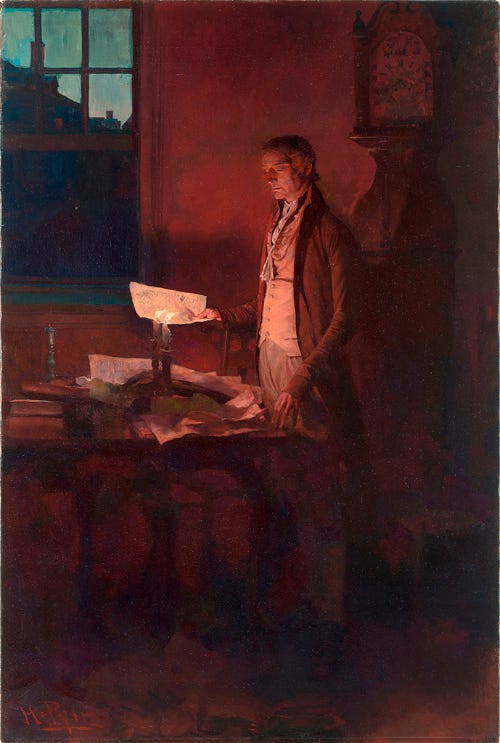
(Howard Pyle, “Thomas Jefferson Writing the Declaration of Independence” (1898); image from Delaware Art Museum.)
In reality, it took Jefferson maybe a week or so to compose his draft. The Declaration was just one of his responsibilities in those weeks, as he was on at least four other committees at the same time. Far from the world stopping while he wrote it, he needed to get it out the door.
As he explained decades later, his job was not to produce something never before thought of, but rather was to be “an expression of the American mind.” In doing so, he drew on George Mason’s just-released Virginia Bill of Rights, John Locke’s philosophy on natural right and government from the Second Treatise on Government, his own thoughts on a constitution for Virginia, traditional English common law, and other influences.
Although he gave his draft to the rest of his committee, only Adams and Franklin appear to have been much involved in editing it. Jefferson kept his draft, editing it as the committee made some changes, though we don’t know who suggested what. Decades later, Jefferson annotated the draft, but we’ll never know whether he remembered accurately whether a particular change was suggested by Franklin or Adams.
At least two changes made by the committee were of paramount importance. In the very first line, Jefferson had written, “When in the course of human events, it becomes necessary for a people to dissolve the political bands which have connected them with another…” (emphasis added). This was changed, most likely by Franklin to “one people,” a crucial alteration that highlighted the Declaration’s unity claim for thirteen very diverse colonies.1
Secondly, Franklin again intervened to change Jefferson’s inelegant line on natural rights to what Walter Isaacson has called “the greatest sentence ever written.” Jefferson had penned: “We hold these truths to be sacred & undeniable; that all men are created equal & independant, that from that equal creation they derive rights inherent & inalienable, among which are the preservation of life, & liberty, & the pursuit of happiness;…” It was Franklin, we believe who stepped in to change “sacred & undeniable” to the magisterial “self-evident.” And someone else, whether Franklin, Adams, or Jefferson, rewrote the line to its eternal form:
“We hold these truths to be self-evident, that all men are created equal, that they are endowed by their Creator with certain unalienable Rights, that among these are Life, Liberty and the pursuit of Happiness.--”2
Jefferson’s original draft was 1689 words (exclusive of the title). It included a long, passionate denunciation of the slave trade, blaming King George III for waging “cruel war against human nature itself, violating it's most sacred rights of life & liberty in the persons of a distant people who never offended him, captivating & carrying them into slavery…” while making clear the humanity and rights of Africans, though not within colonial political society.
Jefferson also made a bitter attack on “our British brethren,” who spurned all attempts by the colonists to assert their rights. Carried away by anger Jefferson’s pen dripped poison: “we might have been a free & great people together; but a communication of grandeur & of freedom it seems is below their dignity. be it so, since they will have it: the road to glory & happiness is open to us too; we will climb it in a separate state, and acquiesce in the necessity which pronounces our everlasting Adieu!”
Neither the condemnation of the slave trade or the attack on the British people survived Congress’ edits, the former being excised completely while the latter was severely cut down and edited.
As the eminent scholar Julian Boyd declared, Jefferson’s draft is “the most extraordinarily interesting document in American history.” Scholars from Carl Becker in the 1920s to Boyd in the 1940s, Pauline Maier in the 1990s, and Danielle Allen a decade ago have explored the path of the Declaration from draft to final version. Both the Library of Congress and the Thomas Jefferson Papers at Princeton have interesting websites tracing the evolution of the Declaration, and you can read the complete draft here.
And, more importantly, starting July 3, you will have a once-in-a-lifetime opportunity to view the draft itself, at the Library of Congress. “The Declaration’s Promise” exhibit will put on display the Library’s number one treasure for the first time since the Bicentennial, in 1976. And while you’re in downtown DC, cross over the National Mall to the Smithsonian, where a special exhibit on “American Aspirations” includes the portable writing desk on which Jefferson composed the Declaration (this exhibit is open until July 26, after which the desk will go back on permanent display in the National Museum of American History).
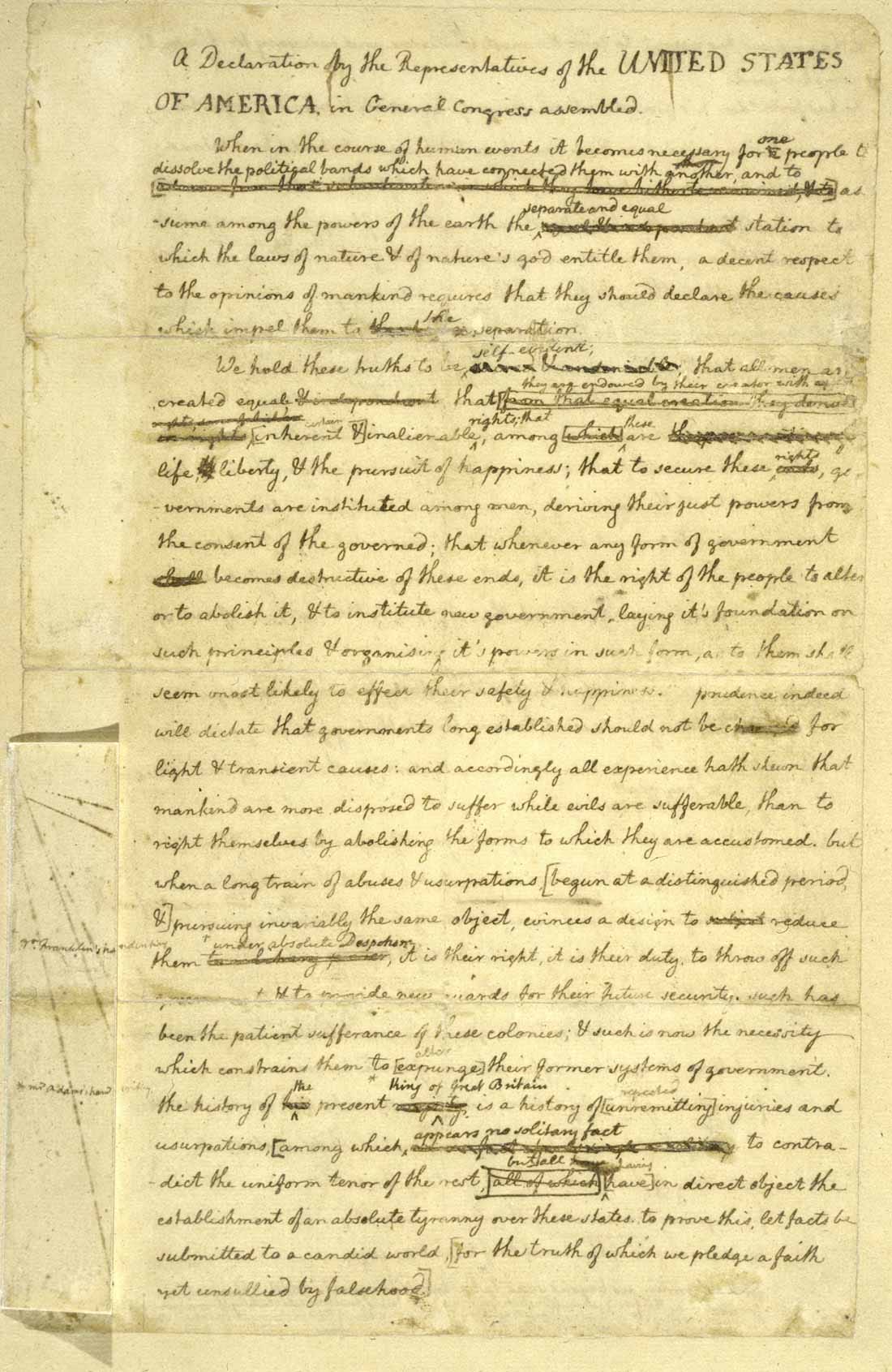
Along with other key documents in American history, Jefferson’s draft will be on display for only a limited time. But take a moment today to imagine the understated moment a quarter of a millennium ago today when the words that would change the world were laid on the table in the Pennsylvania State House in Philadelphia.
As always, the complete story of the Declaration can be found in National Treasure, which I hope you enjoy.
And, if you’re interested, a few of the book events and media interviews I’ve recently done include:
If you’re going to write a book and do a talk on the Declaration, where else but the National Archives would you want to do it? A really meaningful conversation at the Archives on June 11 (the day the Committee of Five was appointed) with Patrick Spero, CEO of the American Philosophical Society.
With Walter Isaacson, on PBS’ “Amanpour & Co.” A very fun conversation on the meaning of the Declaration.
A wonderful fireside chat at the Richard M. Nixon Presidential Library, with Jim Byron, president and CEO of the Richard Nixon Foundation (despite my terrible sinusitis).
Jefferson’s actual first line was even less felicitous: “When in the course of human events it becomes necessary for a people to advance from that subordination in which they have hitherto remained,…” It is believed that either Jefferson or the committee changed this to the much more powerful “When in the Course of human events, it becomes necessary for one people to dissolve the political bands which have connected them with another,…” which also made clear that Americans and Britons were two distinct peoples, a critical political argument.
This transcription is from the National Archives’ official site. Danielle Allen at Harvard has argued that there is no period after the “pursuit of happiness,” but rather a comma and an immediate continuation into “That to secure these rights, Governments are instituted among Men, deriving their just powers from the consent of the governed, --” with a subsequent comma further connecting it to the claim that when the people withdraw their consent, they have the right to alter or abolish a government no longer protecting those rights.
Good post! I just wrote about the edits to the Declaration myself…
https://humanepursuits.substack.com/p/editing-the-declaration-of-independence